May 17, 2008
Peace and Free Trade
Don Boudreaux
Here's a letter that I recently sent to the Wall Street Journal:
Mark Helprin correctly points out that as the Chinese grow more
prosperous their military will grow more mighty ("The Challenge From
China," May 13). He advises that Uncle Sam dramatically increase the
size of his own arsenal.
Regardless of this suggestion's merits
or demerits, the more vital course is for Uncle Sam to immediately
eliminate all trade and investment restrictions with China, and for
politicians to stop threatening further restrictions. Such moves would
speed the integration of China's economy with our own. Being
economically integrated means being economically reliant on each other
- a happy recipe for prosperity and peace.
Want evidence? See
the important work of economists Solomon Polachek and Carlos Seiglie.
Their empirical research leads them to conclude that "international
cooperation in reducing barriers to both trade and capital flows can
promote a more peaceful world."* Want more evidence? Ask yourself how
likely are even a well-armed Canada or Japan to have any interest in
shooting their countless customers and suppliers throughout the U.S.?
The answer, of course, is no more likely than we are to want to shoot
our customers and suppliers throughout those countries
Donald J. Boudreaux
Posted in Trade | Permalink
| Comments (6)
| TrackBack (0)
May 16, 2008
Broder Unwittingly Helps to Expose the Beast
Don Boudreaux
I sent this letter a few days ago to the Washington Post. I truly don't get the faith that so many people have in politicians and in politics.
The Post's dean of political analysts, David Broder, today unwittingly
reveals two malignancies of politics ("The Price of Delay," May 11).
First, politicians are cowards. Broder notes that dozens of Democratic
Senators "desperately" want their party's primary race finally to end,
but still refuse publicly to endorse Barack Obama. Broder quotes
Majority Whip Dick Durbin for an explanation: "They want to avoid hard
votes."
Second, successful politicians must behave
duplicitously. Here's Broder: "Since McCain effectively cinched his
nomination in February and mostly fell out of the news, he has
accomplished a lot. He has targeted potential constituencies with
appearances and messages tailored for them, knowing that other voters
probably are not paying attention." Broder casually adds that "Obama
needs to do similar work."
This isn't leadership; it's cowardly con-artistry.
Sincerely,
Donald J. Boudreaux
Posted in Myths and Fallacies, Politics | Permalink
| Comments (18)
| TrackBack (0)
May 15, 2008
"If Only People Had Half a Clue as to Why this is Happening!"
Don Boudreaux
My and Karol's dear friend Betsy Albaugh -- founder and owner of Betsy Fisher, the wonderful womens'-clothing store near Dupont Circle -- sent this site to me yesterday. In her e-mail, Betsy said "If only people had half a clue as to why this is happening...." Indeed. The market -- humans' "propensity to truck and barter," property rights, reason, a worldwide division of labor and trade -- is why so many of us can sit in our living rooms, press a few buttons, and, by spending only a tiny fraction of our incomes, acquire marvelous goods from around the world.
Posted in The Economy | Permalink
| Comments (11)
| TrackBack (0)
May 14, 2008
Adam Smith on the China tragedy
Russell Roberts
Here is Adam Smith on the human capacity for selfishness and for something that goes beyond selfishness:
Let us suppose that the great empire of China, with all its
myriads of inhabitants, was suddenly swallowed up by an
earthquake, and let us consider how a man of humanity in Europe,
who had no sort of connexion with that part of the world, would
be affected upon receiving intelligence of this dreadful
calamity. He would, I imagine, first of all, express very
strongly his sorrow for the misfortune of that unhappy people, he
would make many melancholy reflections upon the precariousness of
human life, and the vanity of all the labours of man, which could
thus be annihilated in a moment. He would too, perhaps, if he was
a man of speculation, enter into many reasonings concerning the
effects which this disaster might produce upon the commerce of
Europe, and the trade and business of the world in general. And
when all this fine philosophy was over, when all these humane
sentiments had been once fairly expressed, he would pursue his
business or his pleasure, take his repose or his diversion, with
the same ease and tranquillity, as if no such accident had
happened. The most frivolous disaster which could befal himself
would occasion a more real disturbance. If he was to lose his
little finger to-morrow, he would not sleep to-night; but,
provided he never saw them, he will snore with the most profound
security over the ruin of a hundred millions of his brethren, and
the destruction of that immense multitude seems plainly an object
less interesting to him, than this paltry misfortune of his own.
To prevent, therefore, this paltry misfortune to himself, would a
man of humanity be willing to sacrifice the lives of a hundred
millions of his brethren, provided he had never seen them? Human
nature startles with horror at the thought, and the world, in its
greatest depravity and corruption, never produced such a villain
as could be capable of entertaining it. But what makes this
difference? When our passive feelings are almost always so sordid
and so selfish, how comes it that our active principles should
often be so generous and so noble? When we are always so much
more deeply affected by whatever concerns ourselves, than by
whatever concerns other men; what is it which prompts the
generous, upon all occasions, and the mean upon many, to
sacrifice their own interests to the greater interests of others?
It is not the soft power of humanity, it is not that feeble spark
of benevolence which Nature has lighted up in the human heart,
that is thus capable of counteracting the strongest impulses of
self-love. It is a stronger power, a more forcible motive, which
exerts itself upon such occasions. It is reason, principle,
conscience, the inhabitant of the breast, the man within, the
great judge and arbiter of our conduct. It is he who, whenever we
are about to act so as to affect the happiness of others, calls
to us, with a voice capable of astonishing the most presumptuous
of our passions, that we are but one of the multitude, in no
respect better than any other in it; and that when we prefer
ourselves so shamefully and so blindly to others, we become the
proper objects of resentment, abhorrence, and execration. It is
from him only that we learn the real littleness of ourselves, and
of whatever relates to ourselves, and the natural
misrepresentations of self-love can be corrected only by the eye
of this impartial spectator. It is he who shows us the propriety
of generosity and the deformity of injustice; the propriety of
resigning the greatest interests of our own, for the yet greater
interests of others, and the deformity of doing the smallest
injury to another, in order to obtain the greatest benefit to
ourselves. It is not the love of our neighbour, it is not the
love of mankind, which upon many occasions prompts us to the
practice of those divine virtues. It is a stronger love, a more
powerful affection, which generally takes place upon such
occasions; the love of what is honourable and noble, of the
grandeur, and dignity, and superiority of our own characters.
Yes, we are selfish. Yes, many of us slept well last night in the aftermath of the death of thousands in China. But our selfishness does not tell the whole story. Yes, we are self-centered. But there is more to the human enterprise or at least we like to think so.
Continue reading "Adam Smith on the China tragedy"
Posted in Charity | Permalink
| Comments (17)
| TrackBack (0)
Free?
Russell Roberts
The latest EconTalk is Chris Anderson, editor of Wired Magazine talking about the tendency for stuff that isn't free to be free. That is, products and services are increasingly being offered below marginal cost and at a zero price, either to allow revenue from other sources such as advertising or to sell other items at a profit or for other reasons. Chris is working on a book on the topic and is interested in feedback. So have a listen and join the comment thread over at EconTalk.
Posted in Podcast | Permalink
| Comments (0)
| TrackBack (0)
Perspective
Don Boudreaux
My latest essay in the Pittsburgh Tribune-Review is (are you sitting down?) on the benefits of free trade. Here are some passages:
We've all seen a drawing that looks like two very different things
depending upon how the viewer looks at it. In one case, for instance,
what at first appears to be the craggy face of an old woman suddenly
looks like a beautiful woman standing in a sexy pose. If you look for
the old woman in the drawing, you see the old woman. If you instead
look for the gorgeous babe, you see the gorgeous babe.
Same picture. Same objective reality. Two wholly different sightings.
And so it is in economics. The very same set of facts -- the
very same objective reality -- often tells two (or more) very different
stories depending upon the attitude and knowledge that the observer has
when examining these facts. More imports from abroad and the losses of
specific domestic jobs that they typically entail are seen by some as a
sign of trouble for the domestic economy. Others see these same facts
as a boon -- as the opportunity to get valuable goods and services at
lower costs and as releasing scarce domestic labor to produce outputs
that would otherwise be too costly to obtain.
.....
When trade is free, even craggy and slothful economies can be transformed into lively and fertile ones. That's my perspective.
Posted in The Economy, The Future, The Hollow Middle, The Profit Motive, Trade | Permalink
| Comments (22)
| TrackBack (0)
May 13, 2008
Peace and Free Trade
Don Boudreaux
Here's a letter that I sent today to the Wall Street Journal:
Mark Helprin correctly
points out that as the Chinese grow more prosperous their military will
grow more mighty ("The Challenge From China," May 13). He advises that
Uncle Sam dramatically increase the size of his own arsenal.
Regardless
of this suggestion's merits or demerits, the more vital course is for
Uncle Sam to immediately eliminate all trade and investment
restrictions with China, and for politicians to stop threatening
further restrictions. Such moves would speed the integration of
China's economy with our own. Being economically integrated means
being economically reliant on each other - a happy recipe for
prosperity and peace.
Want evidence? See the important work of
economists Solomon Polachek and Carlos Seiglie. Their empirical
research leads them to conclude that "international cooperation in
reducing barriers to both trade and capital flows can promote a more
peaceful world."* Want more evidence? Ask yourself how likely are
even a well-armed Canada or Japan to have any interest in shooting
their countless customers and suppliers throughout the U.S.? The
answer, of course, is no more likely than we are to want to shoot our
customers and suppliers throughout those countries.
Sincerely,
Donald J. Boudreaux
Posted in Cooperation, The Profit Motive, Trade | Permalink
| Comments (20)
| TrackBack (0)
May 11, 2008
A Great Arrrgggument
Don Boudreaux
One of my and Russ's impressive young colleagues, Pete Leeson, has his research discussed in today's edition of the Boston Globe. (HT Pete Boettke)
Leeson makes clear that pirates on the high-seas evolved their own social order, one that makes good sense from the perspective of positive economics. Here's a slice from the article:
The pirates who roamed the seas in the late 17th and early 18th
centuries developed a floating civilization that, in terms of political
philosophy, was well ahead of its time. The notion of checks and
balances, in which each branch of government limits the other's power,
emerged in England in the Glorious Revolution of 1688. But by the
1670s, and likely before, pirates were developing democratic charters,
establishing balance of power on their ships, and developing a nascent
form of worker's compensation: A lost limb entitled one to payment from
the booty, more or less depending on whether it was a right arm, a left
arm, or a leg.
The idea of enlightened piracy is strange swill to
swallow for those steeped in a pop culture version of the pirate -
chaos on the high seas, drinking and pillaging, damsels forced onto the
plank. Sure, there's something about the independence of piracy that
still speaks to people today. (Even the founders of International Talk
Like a Pirate Day acknowledge that there is, in people who love to say
"Aargh," a yearning for a certain kind of freedom.) But it turns out
that pirate life was more than just greedy rebellion. It offers
insights into the nature of democracy and the reasons it might emerge -
as a natural state of being, or a rational response to a much less
pleasant way of life.
To Leeson, pirate democracy was an
institution born of necessity. In one successful cruise, a pirate could
take home what a merchant sailor earned in 50 years. Yet a business
enterprise made up of the violent and lawless was clearly problematic:
piracy required common action and mutual trust. And pirates couldn't
rely on a government to set the rules. Some think that "without
government, where would we be?" Leeson says. "But what pirates really
show is, no, it's just common sense. You have an incentive to try to
create rules to make society get along. And that's just as important to
pirates as it is to anybody else."
So just as Buchanan, Tullock, and Mancur Olson were pioneers in using economics to help us to better understand the behaviors and institutions of stationary bandits, Pete Leeson is using economics to help us to better understand the behaviors and institutions of floating bandits
Posted in Complexity and Emergence, Crime, Myths and Fallacies | Permalink
| Comments (15)
| TrackBack (0)
Stamping Our Feet
Don Boudreaux
Tomorrow, the price of a first-class postage stamp in the U.S. rises from 41 cents to 42 cents. This price hike by a legally protected monopolist (the United States Postal Service) prompts me to reprint the following letter that my friend (and former colleague at GMU) George Selgin and I published in the April 4, 1994 edition of the New York Times:
To the Editor:
It
has been suggested that, because the nominal price of first-class
postage is about where it was in the late 18th century, Americans who
complain about the proposal to increase postal rates are merely whining
wimps who are lacking in historical perspective.
However, the
real price of transportation (a key input in postal service) has
plummeted over the last 200 years. In 1799 it took 53 days for an Army
courier to travel from Detroit to Pittsburgh.
Today the same
trip can conveniently be made in minutes. Likewise, the productive
efficiency of the United States is vastly greater now than it was even
a few decades ago.
Given the plunge in transportation costs,
joined with other technological improvements and a large increase in
the scale of postal activity, the price of postage should have fallen
dramatically.
Americans do not oppose postal-rate increases because of their ignorance of history.
Rather,
opposition to these increases grows from the correct perception that a
legally protected monopolist such as the United States Postal Service
can keep prices higher, and service inferior, to what these would be
under competition.
Regardless of how today's postal rates
compare with rates in the past, opening the delivery of first-class
mail to competition would lower rates still further while improving
service.
DONALD J. BOUDREAUX, G. A. SELGIN
Clemson, S.C.,
March 24,
1994
The writers are, respectively, an associate professor of legal
studies at Clemson University and an assistant professor of economics
at the University of Georgia, Athens.
Posted in Myths and Fallacies, Regulation | Permalink
| Comments (14)
| TrackBack (0)
May 10, 2008
Peru, Trade, and Growth
Don Boudreaux
The Wall Street Journal's Mary Anastasia O'Grady is always worth reading -- and this recent essay that she penned is no exception to this rule. It's entitled "Peru Takes the Other Path." Here's a selection:
Yet price stability on its own would have left the country [Peru] well below
its potential. Far more impressive is the restructuring of the economy,
which has led both to growth and to a more equal distribution of
opportunity. While a boom in commodity prices has certainly fueled
development of late, Peru is also sprouting entrepreneurs in a variety
of nontraditional industries. And these innovators are making their way
onto the global stage.
The key reform that has made all this possible is the
opening of the economy, which until 1990 had very high tariffs designed
to protect local industries.
Peruvian journalist Jaime Althaus documents the
effects of the opening in his 2007 book (Spanish only) titled "The
Capitalist Revolution in Peru." Far from "deindustrializing" the
country, Mr. Althaus argues, trade liberalization has strengthened
Peruvian manufacturing. Under high tariffs, the industrial sector
served mainly as an auto and electronics assembler, using inputs from
abroad. But when protection ended, local manufacturing began to
discover its comparative advantages.
There were plenty. High growth rates – averaging 11% a
year from 1990-2002 – have occurred in sectors that make china,
porcelain, knitted fabrics, plastic products and basic chemicals, to
mention a few.
The story of the "cluster" of small metallurgical
companies that has emerged in Lima is especially compelling. In recent
years, these entrepreneurs have been competitive in bidding for work
that was previously dominated by important international firms. They
have also become exporting powerhouses.
Posted in Trade | Permalink
| Comments (6)
| TrackBack (0)
May 09, 2008
Workers and Employers
Don Boudreaux
Let's reflect on an implicit presumption -- indeed, I'm sure, a presumption held unawares -- that undergirds many familiar discussions of workers' relationships with employers.
This common presumption is that employers generally are philanthropic benefactors of their employees.
Consider that many pundits, politicians, and ordinary folks believe that workers are expendable - that one of the surest and least-painful ways for firms to cut their costs and improve their bottom lines is to fire workers. This belief make sense only if workers contribute little to firms' profits. Put differently, this belief make sense only if, in employing workers, firms don't expect much in return.
In short, this belief makes sense only if most workers are overpaid.
A worker who is not overpaid is a worker whose compensation reflects pretty accurately that worker's contributions to his employer's revenues. So if a firm fires workers who are not overpaid, that firm suffers a loss of revenue at least equal to the compensation that that firm would have to pay those workers in order to keep them in its employ. Such properly paid workers are not expendable; firing them is not key to improving the firm's bottom line.
Of course, if workers are underpaid, the above holds true with special ummpphhh. An underpaid worker is one who contributes more to his employer's revenues than that employer pays to keep that worker on the job. So firing underpaid workers is an especially bad deal for their employers.
So in this view – what we might call the “Progressive” view - workers are seen as contributing little to their employers (which is why employers can so blithely fire workers). At the same time, employers are seen as contributing enormously and philanthropically to their workers. “Enormously” because the presumption is that the typical worker’s next-best employment option would pay him or her much less than he or she makes in the current job, and “philanthropically” because the presumption is that the worker is paid more than he or she is worth to the employer.
Strange economics.
Posted in Myths and Fallacies, Work | Permalink
| Comments (71)
| TrackBack (0)
May 08, 2008
Happy 109th, Fritz!
Don Boudreaux
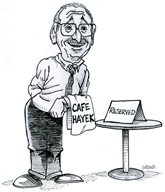
F.A. Hayek was born on this day in 1899. To mark this occasion, I offer a brief passage from page 104 of Hayek's 1973 book Law, Legislation, and Liberty, Vol. 1: Rules and Order:
Maintaining the overall flow of results in a complex system of production requires great elasticity of the actions of the elements of the system, and it will only be through unforeseeable changes in the particulars that a high degree of predictability of the overall results can be achieved.
Interfering with trade and technological advances in order to protect certain producers from disappointment (and, hence, from the need to adjust to changes) not only makes the economy less productive over time, but also infuses it with greater uncertainty.
Posted in Complexity and Emergence, Seen and Unseen, The Economy, The Future, Trade | Permalink
| Comments (8)
| TrackBack (0)
Caplan on the Gas-Tax Holiday
Don Boudreaux
Think the proposed gas-tax holiday is a wacky idea? My GMU colleague -- and EconLog's -- Bryan Caplan gives you good reason to think again.
Posted in Taxes | Permalink
| Comments (27)
| TrackBack (0)
May 07, 2008
Rational Depending on Context
Don Boudreaux
Bryan Caplan's book The Myth of the Rational Voter : rationally, I'm a big fan.
Posted in Myths and Fallacies, Politics | Permalink
| Comments (31)
| TrackBack (0)
May 06, 2008
In Defense of Usury
Don Boudreaux
Especially in light of the renewed efforts to regulate the terms that credit-card issuers are allowed to offer to borrowers, Jeremy Bentham's short little classic Defence of Usury is well worth reading. Below is a germane passage. Writing of a potential borrower whose circumstances put him in desperate need of money, Bentham says
A man is in one of these situations, suppose, in which it would be for his advantage to borrow. But his circumstances are such, that it would not be worth any body's while to lend him, at the highest rate which it is proposed the law should allow; in short, he cannot get it at that rate. If he thought he could get it at that rate, most surely he would not give a higher: he may be trusted for that: for by the supposition he has nothing defective in his understanding. But the fact is, he cannot get it at that lower rate. At a higher rate, however, he could get it: and at that rate, though higher, it would be worth his while to get it: so he judges, who has nothing to hinder him from judging right; who has every motive and every means for forming a right judgment; who has every motive and every means for informing himself of the circumstances, upon which rectitude of judgment, in the case in question, depends. The legislator, who knows nothing, nor can know any thing, of any one of all these circumstances, who knows nothing at all about the matter, comes and says to him—"It signifies nothing; you shall not have the money: for it would be doing you a mischief to let you borrow it upon such terms."—And this out of prudence and loving-kindness!—There may be worse cruelty: but can there be greater folly?
The folly of those who persist, as is supposed, without reason, in not taking advice, has been much expatiated upon. But the folly of those who persist, without reason, in forcing their advice upon others, has been but little dwelt upon, though it is, perhaps, the more frequent, and the more flagrant of the two. It is not often that one man is a better judge for another, than that other is for himself, even in cases where the adviser will take the trouble to make himself master of as many of the materials for judging, as are within the reach of the person to be advised. But the legislator is not, can not be, in the possession of any one of these materials.—What private, can be equal to such public folly?
Posted in Prices, Regulation | Permalink
| Comments (42)
| TrackBack (0)
May 05, 2008
Nye on wine (and war and taxes)
Russell Roberts
The latest EconTalk is John Nye talking about his book, War, Wine, and Taxes. John has many interesting insights into the political economy of trade, the history of trade policy, and why Ricardo's canonical example of comparative advantage is particularly weird.
Posted in Podcast, Trade | Permalink
| Comments (0)
| TrackBack (0)
The Coming Recession?
Don Boudreaux
Along with persons far more insightful than me, I offer a few thoughts on the current economic downturn in the new issue of Reason.
Posted in Current Affairs, Politics | Permalink
| Comments (6)
| TrackBack (0)
May 04, 2008
Fair Advice
Don Boudreaux
I've never been invited to deliver a commencement address. And I probably should never be so invited, for I already know the title I would choose: "Don't Change the World." I would explain that it's okay -- indeed, admirable -- to change the world marginally, incrementally, by engaging in voluntary actions. But all the "change the world" talk that high-school and college graduates get presumes that change, any change, is desirable -- as if the world is such a decrepit place that nothing about is worth preserving (except, of course, "the environment"). And all this "change the world" talk also tends to presume that doing things politically is the best way to effect worthwhile change. (Update: Reader Bob Ewing kindly suggests that I add a link to this article of mine that develops this point further.)
Anyway, I digress..... for the reason I post today is to recommend that you read P.J. O'Rourke's commencement-address-like ruminations. (HT to Tom Hazlett) Here's one of my favorite passages:
Life sends the message, "I'd better not be poor. I'd better get rich.
I'd better make more money than other people." Meanwhile, politics
sends us the message, "Some people make more money than others. Some
are rich while others are poor. We'd better close that 'income
disparity gap.' It's not fair!"
Well, I am here to advocate for
unfairness. I've got a 10-year-old at home. She's always saying,
"That's not fair." When she says this, I say, "Honey, you're cute.
That's not fair. Your family is pretty well off. That's not fair. You
were born in America. That's not fair. Darling, you had better pray to
God that things don't start getting fair for you." What we need is more
income, even if it means a bigger income disparity gap.
Posted in The Economy | Permalink
| Comments (21)
| TrackBack (0)
May 03, 2008
On Smuggling and Law
Don Boudreaux
My colleague Walter Williams offers great good sense here.
When legislation is harmful -- such as when it attempts to restrict the carrying out of peaceful exchange among consenting adults -- it is widely disrespected. One of the many unfortunate consequences of harmful legislation is that the disrespect it engenders risks becoming disrespect for law. Legislation is not at all synonymous with law.
Posted in Law, Nanny State, Regulation | Permalink
| Comments (27)
| TrackBack (0)
May 02, 2008
Seeing Past the Chicken Littles
Don Boudreaux
Denver Post columnist David Harsanyi is superb.
Posted in Current Affairs, Politics, The Economy | Permalink
| Comments (20)
| TrackBack (0)